The purpose of the "Spiritual Successors" entries is to figure out one thing about an artist/group: will another similar artist ever come along after that achieves similarly to the original group.
This requires a few things:
1. Spiritually similar. Are they both trying to achieve the same thing? This could be from being highly political to highly introspective/spiritual. As long as they are the same or similar, then we can consider the later the successor of the former.
2. Following from 1., but also of import: being a spiritual successor does not mean they have to be stylistically similar...not at all. For one, being overly restrictive limits options, and two, the nature of music has been dynamic, with different things "in" and different things "out," which means that what's good one era is not good in another (ahem, punk). To apply an analogy, if you expect yourself to be reincarnated, you wouldn't be reincarnated as "yourself," no? You would be reborn in a different vessel and do things in a unique way.
3. Similar music "methodologies." This mostly concerns the approaches that both the predecessor and the follower take to the music. Are they both generally eclectic and incorporate all sorts of elements into their music? Or do they both prefer to ply the trade they have perfected? The general consensus is here that the sorts of spiritual successor strains will be of the "eclectic" variety; most artists tire of continually "plowing their own field" (to use the vernacular of a bygone era) and choose to try something new, or to at least incorporate something new.
That being said, this does not imply that there will always be a spiritual successor for a group before. The Beatles are a good example of such. While perhaps I can discuss this at a later date and prove that no group has been able to recreate the Beatles with any degree of success, the point to make is that the Beatles were so good, so unique, so diverse in what they achieved that no artist has ever come close to the creative burst that powered their years. It really was a perfect storm for them.
Now that I've outlined the guidelines for the "Spiritual Successors" series, let's begin...
---------
The Clash were regarded as "the only band that matters," as said by pretty much everyone. Roaring along in the 1970s, they were the distinctly political side of punk. With anthems such as "White Riot" which promoted action (i.e. violence) and even the dirges such as "Straight to Hell" (hint...this song will come into play later), they lamented their lot in life much like the rest of the punk movement, but what separated them from the rest of the chaff was their willingness to try to change it.
And they were simply good. When you put on the Clash and hear "Clash City Rockers" explode out of your speakers for the very first time, the riff is quite simply embedded in your head for the rest of your life. In typing that last sentence, the riff just came bubbling out of the blue, a sort of semi-conscious recall that implies a sort of timelessness to their work (no matter how dated the punk movement became). And yes, before purists cry out, when I refer to "Clash City Rockers" playing from the Clash, I am, in fact, referring to the U.S. version of the record that came out post-Give 'em Enough Rope, as the U.K. version was never available in the United States...and, well, I'm from the United States.
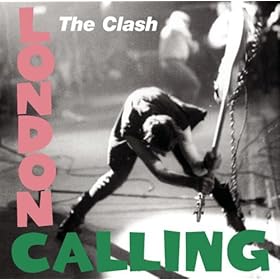
Then there was their seminal record: London Calling. There is no need to defend the record. But it's important to point out how eclectic the record is in comparison to their previous ones (and to basically most records in existence). They started incorporating reggae, they dabbled in parlor jazz, noisy blues-rock, and the like. Nothing was off limits, because punk was about "no limits," not the power chord. The pop of "Train In Vain." The sinister crawl of "The Guns of Brixton." The apocalyptic march of the title track. Need I go on?
While perhaps Sandinista! was a strange choice, it pushed the boundaries of what "eclectic" meant. If you want an explanation (and don't want to trudge through 3 LPs, which at times is hard to manage), then look no further than the children's chorus version of one of their more famous "old school punk" songs, "Career Opportunities." It was already a highly political message in its first form, and given the new dressing, gained an especially vicious edge to its commentary.
As I said earlier, it was their political stance that separated them from the rest, the men from the children (so to speak). No one dared to get explicitly political, because there was always a sense of fear given that if you were outside the box, you would never get anywhere. Of course, given the Clash, getting anywhere was not really the issue, because they started nowhere, so somewhere was better than there. But most of all, they were simply bold enough to insert themselves into the political issues of the time (see the title of their fourth record: Sandinista! and you see).
So we see two trends from the Clash: while at first content to stew their own pot, they later became quite eclectic in their approach. They were also highly political (and generally great people to boot, but that's a separate entry), unafraid to confront their lot in life, and to make a stand and send a message. Is there anyone who, perhaps, can be viewed as their spiritual successor? I say yes. It is, in fact, this artist/person:

M.I.A., as she's known, is essentially a rapper from London, I believe, who traces her roots back to Sri Lanka. Her two records, Arular and Kala, are dizzyingly eclectic, with noises and sounds, thick and dirty beats flying in and out, all tied together by her verses. Stylistically, the two are far apart. Rap vs. punk, and you see a stark contrast, an uncrossable rift between the two. But neither artist treated their respective genres as a chafing categorization, but moreover a springboard to something new. The Clash incorporated reggae primarily, alongside almost every other genre into their songs, while M.I.A. has been fearless in her sampling of tracks that make her songs unmissable (in fact, "Straight to Hell" was sampled in M.I.A.'s "Paper Planes," which was her mainstream hit...it all makes sense now, no?). While the methods of each artist's eclecticism are different, that seems to be a product of the dynamic state of music, rather than an inherently different approach to their music.
While she does not dedicate herself to political material (not even the Clash did that), the amount of it is staggering and is likely comparable to that of the Clash. Of course, M.I.A. has probably been better off than the Clash have ever been in a financial sense, but M.I.A., like the Clash, took one issue to heart (the Clash's was essentially the poor standard of living in London, though usually more general than just London). Her core issue relates to her ancestry in Sri Lanka, specifically concerning the Tamil uprising and the conflict that enveloped the region (and, I would hazard to guess that it's probably not as over as some people like to think).
The comparison seems fairly apt. Both highly political, both highly eclectic. While perhaps I have not treated the "issue" (though I don't consider a faux-academic examination of an aspect of rock music to be much of a pressing "issue," much less an actual "issue") with as much depth as it may deserve, I think in general, the point has been made and brought up for discussion.
Also, M.I.A.'s new track, "Born Free," is ridiculously awesome, which partially inspired me to write the first entry to this series (I had the idea for the series already, just hadn't gotten around to it yet).
Showing posts with label the Clash. Show all posts
Sunday, April 25, 2010
Thursday, February 4, 2010
Punk Primer
It seems rather useless to write about punk, to be honest. Punk is about the gut feeling. Punk is about harnessing feelings. So what is the use of writing about punk? You put on punk, you get lost in the masses. But, as usual, the scholarly side of me (though there is not much that is scholarly about rock music) wants to break it down and present my theories and concepts with regards to punk music. So here goes...the nature of punk music says that what I'll be saying is useless and that you should ignore it (see: the "Ignore Alien Orders" sticker emblazoned on Joe Strummer's guitar), so do what you will:
Punk music essentially started with, well, proto-punk. Quite obvious, really. But where does proto-punk begin? I would argue that it began with the Velvet Underground. "I'm Waiting for the Man" and "White Light/White Heat" (to just name a few) move forward almost recklessly, propelled forward by some supernatural force. Trademark punk sound (which, as I will argue, hardly defines punk) is not there, but certainly the aesthetic was bred (reckless abandon) by the Velvet Underground (the White Light/White Heat record in its entirety is a pretty damn good lesson in proto-punk, but it's not for the faint of heart).
But, when most people envision proto-punk, it's not the Velvet Underground. It's the Stooges. These guys, for the unfamiliar (shame on you if you are unfamiliar):
That's the cover of what's arguably the most influential record in the development of punk music. It's strikingly simple (a classic hallmark of "punk" but not necessarily true), it's angry, it's mad, but it exhibits what I think is the classic "feeling" associated with punk music: alienation. The guitars bite, the guitars snarl, the bass is sinister, the drums insane, and everything just sounds like it's barreling forward only to self-destruct (another classic hallmark). Raw Power is simply one of the finest records around. I'm not sure where I would rank it, but it's really damn good. Ironically, everyone involved with Raw Power says that no mix of it is good (there are "Bowie Mix" haters, "Iggy Mix" haters, "Rough Mix" haters, and all). But that's not the point, because irrespective of the mix, this record shows proto-punk at its finest (and it actually outclasses many, many, punk records).
But onward to punk. The aforementioned feeling of alienation drives punk. Disillusionment with the establishment, the loss of connectedness to the world around, those are the feelings that drive punk. Alienation typically leads to either apathy or the outright rejection and revolt towards the offenders, and those choices are a very good approximation of the punk dichotomy. Naturally, I would hesitate to offer strict dichotomies when it comes to punk music, because artists can easily dip back and for, to and fro from one side of the dichotomy together, but it presents a stark view of the way punk music was an outlet for frustrations towards the alienation they faced. To put it in a more or less succinct manner, if you were punk, you were either a nihilist or an activist.
Nihilism is generally regarded as the not caring about anything. This camp is the apathetic camp, who have chosen to not care about their situation: they are essentially to disillusioned to even care about much at all and would much rather self-destruct than deal with it. I would argue that the Sex Pistols embodied this nihilistic side the best. The easy thing to do is point to the implosion of Sid Vicious, but I'm going to instead point to the track "No Feelings" off of, well, their only record. "I got no emotions for anybody else, you better understand...I'm in love with myself" is an example of pure nihilism.
The activists in the punk movement are your politi-punk bands, who choose to care and try to change their situation, and if they can't peacefully, well, force isn't out of the question. The Clash are the prime example of this. "White Riot" speaks, well, of itself, calling for drastic action because they have been sidelined and ignored (not in terms of race, mind you, but it's a class struggle). It's inherently possible to say that these groups were a bit Marxist, but when you're the lower class, a lot of things become an issue of class conflict.
But punk, after the feeling of alienation, is an aesthetic or mindset more than anything else. It's not "three chords and a sneer," which is apparently how most people define punk. Punk knows no limits. How else can you examine the fact that London Calling is so much more than just a punk record? It mashes anything and everything together to create a supernatural experience, but you still always know that they're all about the issues, but they just take care of it more than anyone else. Perhaps the blame can be put on punk itself. Punk prided itself on its simplicity, and so it became associated with less when it wanted to say more.
Joe Strummer, as I recall, said that punk is what you want it be, what you make it out to be, and you better damn well believe him. Even with the Mescaleros, his later output, such as Global A Go Go, I still saw that as a punk record. Just punk with an ear towards world music. You look at punk groups who have also seen "righteous" success (I'll deal with my usage of the term "righteous" here in a bit) and you see the Minutemen, whose Double Nickels on the Dime record stretches punk's sound to crazy limits while still definitively carrying the punk spirit.
And I come to my use of the term "righteous." There was a neo-punk movement in the 1990s powered by the likes of Green Day and blink-182 and the ilk. Let me just say that none of it is very good. They mostly capitalized on the "three chords and a sneer" and tried to run with it. And those groups got popular by abusing the spirit of punk. Dookie was probably the best of the crop, but in terms of where it belongs, it still doesn't rank very highly (it's a rather nihilistic record, and in that area, you can't come within a universe's length of the Sex Pistols there). Still, it's damning to see the way punk has been despoiled and stained. There are a few groups carrying the spirit of punk, but I'm not sure that I could call them completely punk bands.
I'm not sure we will ever see another truly punk band out there. I think our last chance left with this guy:
He was the last great punksman (if such a term could ever exist), the last shining light of hope where all was dark. Rest in peace, Joe Strummer (1952.08.21-2002.12.22). Every time I think about punk, I think about this angelic figure. The unlikely revival of punk kills me, because "righteous" punk music was the first thing I'd ever gotten into.
Labels:
Punk,
the Clash,
the Sex Pistols,
the Stooges,
The Velvet Underground
Friday, April 24, 2009
Records of Great Influence (#1): the Clash - London Calling
I shouldn't have to defend this record for its artistic merit. It's an utterly useless exercise (because it shouldn't need to be said), and if I honestly have to defend it I will go bonkers. That being said, this was the record that changed my life. I'm really not going to lie about that. Let me state my case:
When I was in high school, for better or for worse, I got caught up in what I consider to be the "neo-punk" movement. Green Day, blink-182, the works. Not only is this not really what can be considered "good" to "great" music, it started me down a bad road. I'm not saying I got to the point of drugs or anything, but I started hanging out with less than savory crowds and who knows what would have happened if I had stayed there. To me, punk and "neo-punk" was a sound, pure aggression, little else. There was a bad guy, and a worse guy. Fight the power with any means necessary, while languishing in the recesses of society. That's the kind of view I was surrounded with. Perhaps in retrospect I'm simplifying the situation or casting my situation in the early high school years as worse than they actually were, but at least now in retrospect I see that period of my life as close to a dead end as I could have ever been. But this record changed every single thing that I thought was true, and changed me.
I realized after this record that punk wasn't a sound. Punk was not about heavy distortion and power chords. It wasn't the balls-to-the-walls, blow-shit-up, or the backed-into-a-corner-and-about-to-explode mentality that I had thought it was. Thanks to Joe Strummer, I realized punk was an aesthetic. More or less, it was a do-it-yourself mentality. No one gives you your breaks; you make them yourself. But moreover, punk music is more or less what you make of it. This point was hit home on another record I might talk about down the road, the Minutemen's Double Nickels on the Dime. There were things in this world that you could change, and that should be the driving force in all you can do. It's common sense, but music often doesn't promote it. But the Clash were common sense, in their own way. In some ways they exhibited the tenets of "neo-punk" that I've railed against thus far, but the Clash differs in that they actually meant what they said. They meant change. "Neo-punk" loves staying in their corner, singing about how they'll explode and change the world, but doing nothing about it. Utterly useless. The Clash? They meant what they said, and their word was good.
They meant good...they meant to change what they could. Tales of generosity about the Clash are many, but the best (and funniest) concern the sales of their records at outrageously low prices. To sell London Calling as a double album for the price of one, the story says they managed to con the record company into attaching another EP record (or similar short-play format) to their standard album by saying they were including a B-side when in fact they were including another disc entirely. Reportedly, the Clash forwent the royalties on Sandanista! to sell the triple-album for the price of one. And perhaps the most telling, Joe Strummer would wait and talk to every fan who wanted to talk, after every show. These were real guys. Fame didn't get to them. They were real dudes, but they had a mission. They weren't just malcontents, they were malcontents who knew they had every power in the world to make things right. And that's the crux of the record. And that's the crux of how I changed entirely. Small changes can yield great results.
Subscribe to:
Posts (Atom)